
Emergency Trolleys
Pre-configured crash carts and resuscitation trolleys — ready in under two minutes.
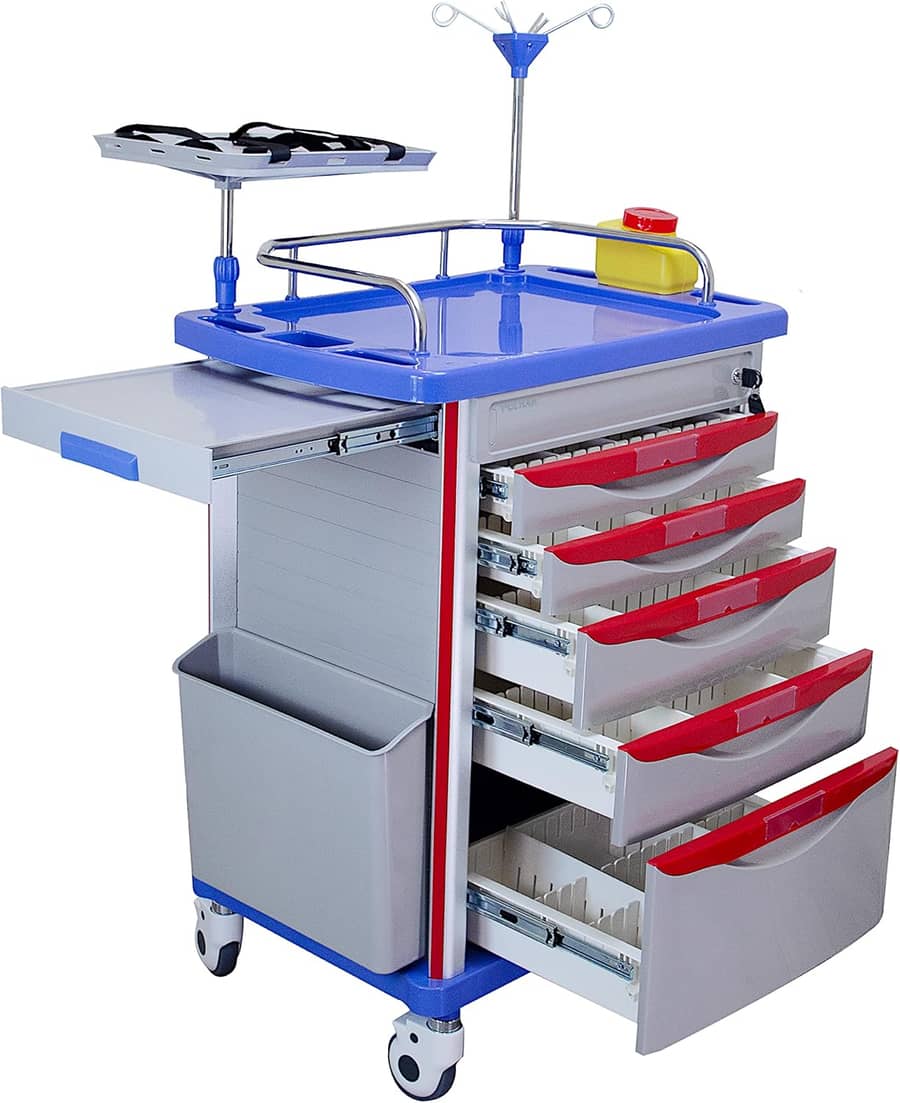
A cardiac arrest gives you four minutes before irreversible brain injury begins. The trolley must be at the bedside and ready before the team arrives.
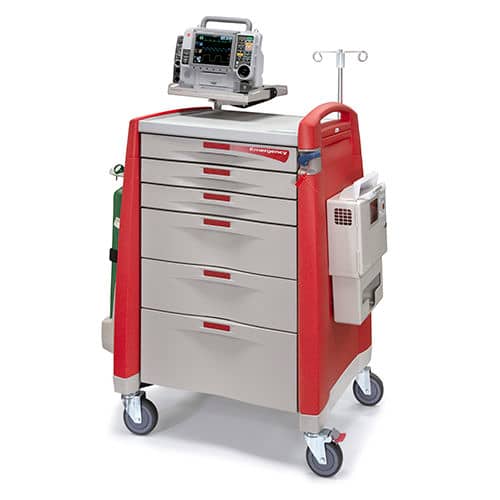
Pre-configured emergency (crash) trolleys combining a defibrillator, complete airway management kit, intravenous access supplies and colour-coded medication drawers in a standardised, rapidly deployable unit. Built to ILCOR and ERC resuscitation equipment standards with lockable drawers, tamper-evident seals, restocking checklists and a defibrillator bracket integrated into the trolley frame. Configured for African hospital resuscitation drug formularies — adrenaline, amiodarone, atropine, sodium bicarbonate, lignocaine — with standardised drawer layouts that allow any team member to locate any item without prior experience of that specific trolley. Jos•Hansen supplies, stocks and maintains emergency trolleys with local consumable restocking, defibrillator pad subscription and PPM across East Africa.
Sub-2-minute resuscitation readiness
Standardised pre-configuration means the resuscitation team arrives to find airway equipment, defibrillator, IV access kit and emergency medications in defined, colour-coded positions — not a drawer rummaged through during the arrest. Tamper-evident locks confirm the trolley has not been accessed since its last check. Restocking checklists and sealed drug drawers keep the trolley in verifiable ready state between use.
Integrated defibrillator
AED and manual defibrillation capability in the same bracket-mounted unit — the defibrillator is part of the trolley, not a separate device to be retrieved from a charging station. AED advisory mode supports non-cardiologist clinicians in identifying shockable rhythms. Manual mode gives the cardiologist or emergency physician full control over energy selection and synchronised cardioversion for AF and other non-arrest arrhythmias.
Colour-coded standardised layout
Red drawer — cardiac drugs. Blue drawer — airway equipment. White drawer — IV access and fluid management. Standardised across all trolleys in the facility, so any nurse or doctor from any ward can locate the defibrillator pads, adrenaline and ETT without hesitation — even in the first seconds of a resuscitation in an unfamiliar department.
Why standardisation saves lives during cardiac arrest.
The Resuscitation Council recommends that all crash trolleys within a hospital use identical drug and equipment layouts. Studies of in-hospital resuscitation show that time-to-first-shock is the single strongest predictor of survival from shockable cardiac arrest — every 1-minute delay in defibrillation reduces survival by approximately 10%. Delay occurs when team members search for equipment in non-standardised drawers, when the defibrillator is not charged, when pads are the wrong type for the defibrillator, or when the airway kit does not contain the size of ETT required. A pre-configured, standardised, checked crash trolley eliminates all of these failure modes. Jos•Hansen works with each hospital's resuscitation committee to configure trolley layouts to the facility's formulary and clinical protocols — then supplies all trolleys with the same layout across the building.
Airway management equipment — every component for every scenario.
The airway drawer contains a bag-valve-mask (BVM) with adult, paediatric and neonatal masks, a laryngoscope with blade sizes 3 and 4, endotracheal tubes in sizes 6.0 through 8.0 with 10 mL syringes and securing tape, a bougie, oropharyngeal airways in sizes 2–5 and a suction device — every component required to manage the airway in a cardiac arrest or failed airway emergency. Supraglottic airway devices (LMA) are available as an addition for units where nursing staff are trained to use them. Video laryngoscopy attachment brackets are available for units with video laryngoscope systems. Jos•Hansen stocks all replacement airway components and ensures restocking within 24 hours of use.
Consumable restocking, pad subscription and defibrillator PPM.
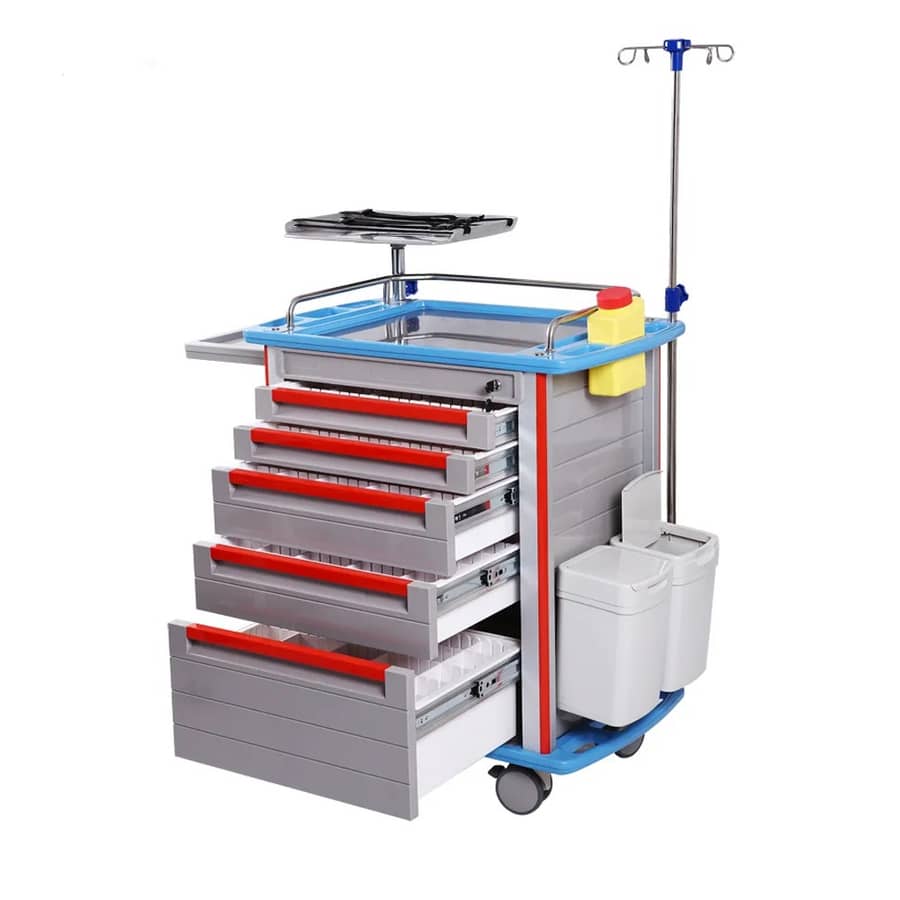
A crash trolley that has been used and not restocked is not a crash trolley. Jos•Hansen offers standing restocking agreements — delivering replacement medications (in sealed, pharmacy-dispensed packs), defibrillator pads, IV cannulae, fluids, syringes and airway consumables within 24 hours of notification of use. Defibrillator pad subscription programmes ensure pads are replaced before expiry dates, electrode gel is current and the defibrillator battery is maintained at full charge capacity. Annual defibrillator PPM includes shock delivery testing, battery capacity measurement, display and alarm verification — the maintenance that confirms the defibrillator will deliver the programmed energy when required.
Technical specifications.
Defibrillator
AED + manual mode · synchronised cardioversion · 200J biphasic
Airway kit
BVM · laryngoscope · ETT 6.0–8.0 · bougie · OPA sizes 2–5
Medication drawers
Colour-coded lockable · tamper-evident seals · restocking checklist
Cardiac drugs
Adrenaline · amiodarone · atropine · NaHCO3 · lignocaine
IV access
Cannulae · extension sets · infusion fluids · pressure bag
Mobility
4-wheel locking castors · push-bar · defibrillator bracket integrated
Reduction in survival probability for every 1-minute delay in defibrillation after shockable cardiac arrest — the clinical case for a charged, ready, immediately accessible defibrillator
Target resuscitation readiness time with pre-configured crash trolley — team arrives to find every required item in its defined position without searching
Jos•Hansen consumable restocking turnaround after trolley use — ensuring every crash trolley is back in verified ready state within one working day
Why Emergency.
Pre-configured readiness
Standardised drug and equipment layout with tamper-evident seals — every team member locates every item without hesitation, regardless of which ward or department they work in.
Integrated defibrillator
AED and manual defibrillation in a bracket-mounted unit on the trolley — the defibrillator is always with the trolley, charged and ready, not retrieved from a separate charging station.
Hospital-wide standardisation
Jos•Hansen configures all trolleys in a facility to identical drug and equipment layouts — eliminating the equipment-location delays that reduce first-shock survival rates.
24hr restock and PPM
Standing restocking agreements, defibrillator pad subscription and annual PPM ensure every crash trolley remains in verifiable ready state between uses.
Partner with Jos Hansen
Talk to our procurement and operations teams about your next infrastructure, healthcare or scientific deployment.